2026 Asia Pacific Cost of Living
2026-10-05
Xpatulator’s Asia Pacific cost of living rankings as at 1 October 2026 place Hong Kong, China 1st, Singapore 2nd and Sydney 3rd, followed by Shanghai, Wellington and Auckland. Shanghai rises 2 places to 4th, Beijing rises 2 places to 11th and Taipei rises 3 places to 13th, while Adelaide declines 4 places to 16th and Seoul declines 2 places to 20th. Housing remains particularly important in Hong Kong and Singapore, while Australian and New Zealand cities face substantial transport, household goods and housing costs. Currency movements, renewed energy inflation and the region’s differing levels of import dependence continue to affect expatriate purchasing power.
Xpatulator’s Asia Pacific cost of living ranking as at 1 October 2026 places Hong Kong, China 1st with a weighted Cost of Living Index of 119.5, followed by Singapore at 116.7 and Sydney at 102.5. These are the only three regional locations above the New York City benchmark of 100. Shanghai rises 2 places to 4th at 97.5, followed by Wellington at 96.7 and Auckland at 94.3.
The ranking includes locations classified as City and City Country State. All ranking positions and movements are calculated only within this Asia Pacific selection, rather than against all 780 Xpatulator locations. Xpatulator compares 13 expenditure baskets weighted according to spending by international professionals and managers. Accommodation has the largest weighting at 30 per cent, transport 18 per cent and groceries 16.5 per cent, so the result is an expatriate cost comparison rather than a general consumer price measure.
Hong Kong, China remains 1st, although its index declines from 120.9 in July to 119.5. Accommodation remains the principal pressure, with an index of 179.6, reflecting limited land and strong demand for suitable rental housing. A recovery in financial activity and professional recruitment has also brought people back to the city during 2026. The Hong Kong dollar’s link to the United States dollar means foreign exchange movements have relatively little direct effect on its ranking.
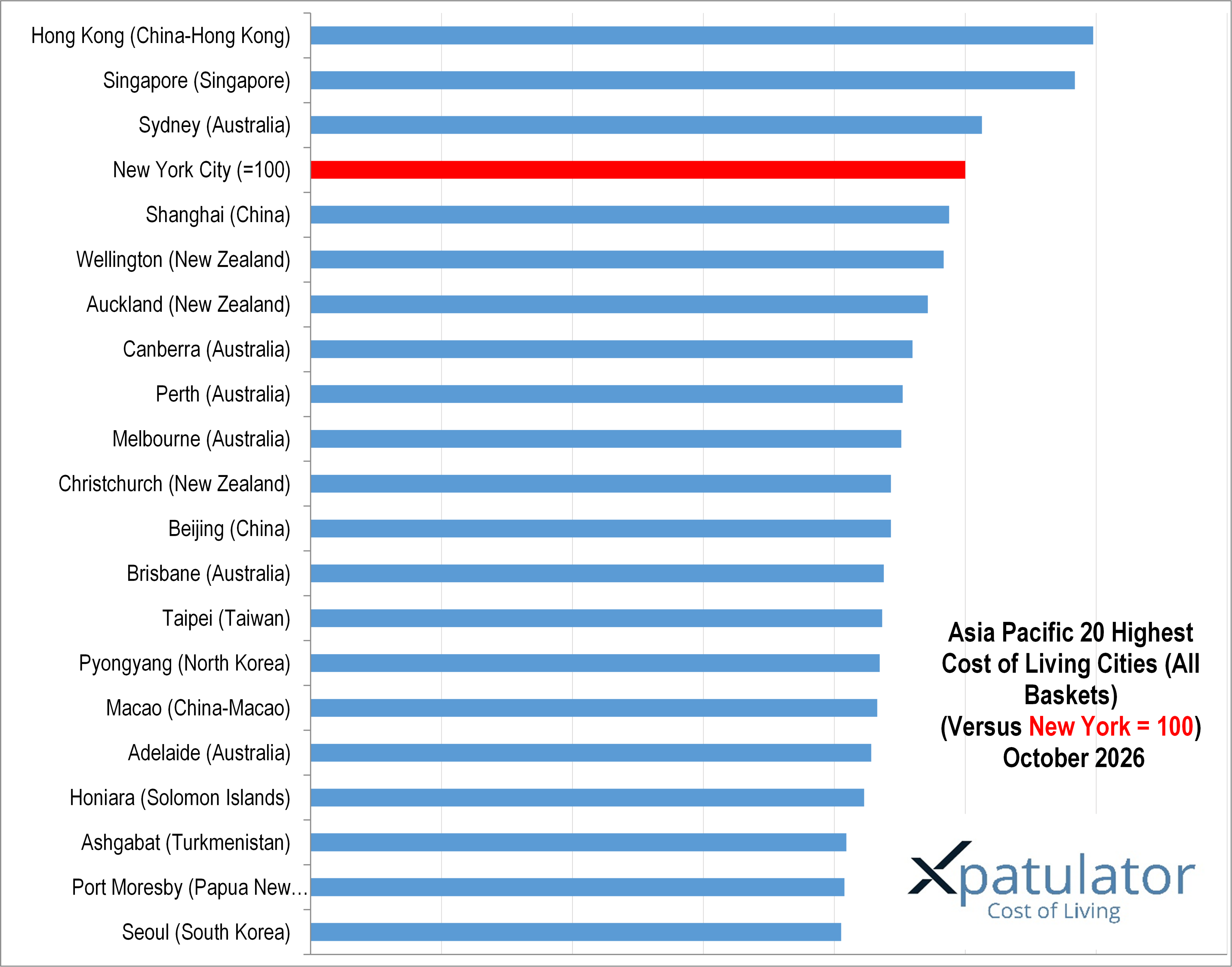
Singapore remains 2nd, although its index declines from 117.9 to 116.7. Personal care, alcohol and tobacco, transport and accommodation are particularly expensive. Inflation remains moderate but has begun to firm, with headline inflation at 2.3 per cent and core inflation at 2.2 per cent in August. Singapore manages monetary conditions through the exchange rate, and further tightening was expected in October as higher oil and food costs presented renewed inflation risks.
Sydney remains 3rd, while Canberra, Perth and Melbourne remain 7th, 8th and 9th. Brisbane declines 1 place to 12th and Adelaide declines 4 places to 16th. All six Australian cities record lower indexes than in July. Furniture and appliances, transport, clothing and miscellaneous expenditure are important costs, while housing remains a significant household pressure. Australian inflation accelerated to 4.0 per cent in August, with housing prices in the Consumer Price Index rising 5.7 per cent. The Australian dollar was also affected by renewed United States dollar strength in September, reducing converted costs from earlier quarterly levels.
New Zealand follows a similar pattern. Wellington declines 1 place to 5th, Auckland declines 1 place to 6th and Christchurch remains 10th. Furniture and appliances, transport and other household expenditure are comparatively expensive, while geographical distance raises freight and import costs. New Zealand inflation reached 4.1 per cent in the year to June, driven substantially by fuel and electricity. The New Zealand dollar fell from 0.57825 United States dollars on 30 September 2025 to 0.56405 a year later, which reduced the international converted cost for an employee paid in United States dollars, while also making imports more expensive locally.
Shanghai rises 2 places to 4th despite its index declining slightly from 97.9 to 97.5, showing that rankings are relative. Accommodation and international education remain major expatriate costs. Beijing rises 2 places to 11th at 88.6, with education, personal care, clothing and transport important. China continues to experience relatively subdued consumer price pressure and weak domestic demand, but the yuan reached its strongest level against the United States dollar in more than three years during September. A stronger host currency increases converted costs for dollar paid expatriates.
Taipei rises 3 places to 13th at 87.3. Accommodation, healthcare, groceries and miscellaneous expenditure remain significant. The New Taiwan dollar weakened from about 30.45 per United States dollar on 1 October 2025 to 31.84 on 1 October 2026, which would normally reduce dollar converted costs. Taipei nevertheless moved higher, indicating that local basket movements and changes elsewhere in the ranking outweighed the currency effect. Taiwan’s strong technology export economy continues to support activity, although cross Strait tensions remain a separate assignment risk consideration rather than a cost of living measure.
Pyongyang remains 14th at 86.9 and requires particular caution in interpretation. Miscellaneous expenditure, recreation, transport and alcohol and tobacco are high in the Xpatulator basket, while sanctions, restricted markets and limited availability of internationally comparable goods can affect pricing. Macao remains 15th at 86.5, where its compact market, tourism sector, accommodation and international education contribute to expatriate costs.
Honiara remains 17th at 84.5. Communication, personal care and recreation are comparatively expensive, reflecting a small market and reliance on imports. The International Monetary Fund expects Solomon Islands inflation to average 5.4 per cent in 2026, with higher energy and import costs linked partly to global conflict. Ashgabat rises 2 places to 18th at 81.8, with unusually high clothing, communication, restaurants and alcohol and tobacco indexes. Turkmenistan’s restricted market and dual exchange rates can make international price comparisons more complex.
Port Moresby remains 19th at 81.5, where communication and suitable accommodation are particularly expensive. Import dependence, infrastructure constraints, transport reliability and security requirements can make an international assignment considerably more costly than average local expenditure would suggest. Papua New Guinea’s foreign exchange shortages have eased during 2026, although the International Monetary Fund still describes the broader social and economic environment as fragile.
Seoul declines 2 places to 20th at 81.0. Groceries, clothing and miscellaneous expenditure are among its higher baskets. South Korean inflation eased to 2.9 per cent in September, although petroleum products and transport remained under pressure. The South Korean won has strengthened more recently, illustrating again that currency movements and local basket prices can move in opposite directions.
Across the region, inflation risks have become less uniform. Xpatulator’s international inflation analysis dated 5 October 2026 notes renewed pressure from energy, food and freight. Oil above 100 United States dollars per barrel and higher global food prices are particularly important for remote and import dependent economies. A strong United States dollar can reduce converted living costs in some locations, but also raise the local price of dollar priced energy and imports.
For expatriates and global mobility specialists, the practical issue is salary purchasing power rather than nominal salary. A higher salary in Hong Kong, Singapore, Sydney or Wellington may still leave less disposable income if housing, transport, healthcare, education and groceries absorb a greater proportion of earnings. Xpatulator’s Salary Purchasing Power Parity Calculator estimates the equivalent host salary required after adjusting for cost differences, allowing an international offer to be assessed on purchasing power rather than salary alone.
Use Xpatulator’s Cost of Living Calculators and Tools to compare home and host locations, assess the effect on salary purchasing power and determine the salary, allowances and international assignment package required to maintain a comparable standard of living.